

If your father had a heart attack before age 55, or your mother before 65, you face a serious reality. Your statistical baseline for a cardiac event silently doubles by the time you reach middle age.
Most people believe a family history of heart disease is a guaranteed death sentence. This belief leads to paralyzing anxiety or dangerous denial. But you do not have to wait for a heart attack to happen.
You can take control today. Modern medicine gives us clear tools to prevent premature heart disease. In this guide, you will find the exact screening protocols updated for 2026.
What Family History Actually Means for Your Heart
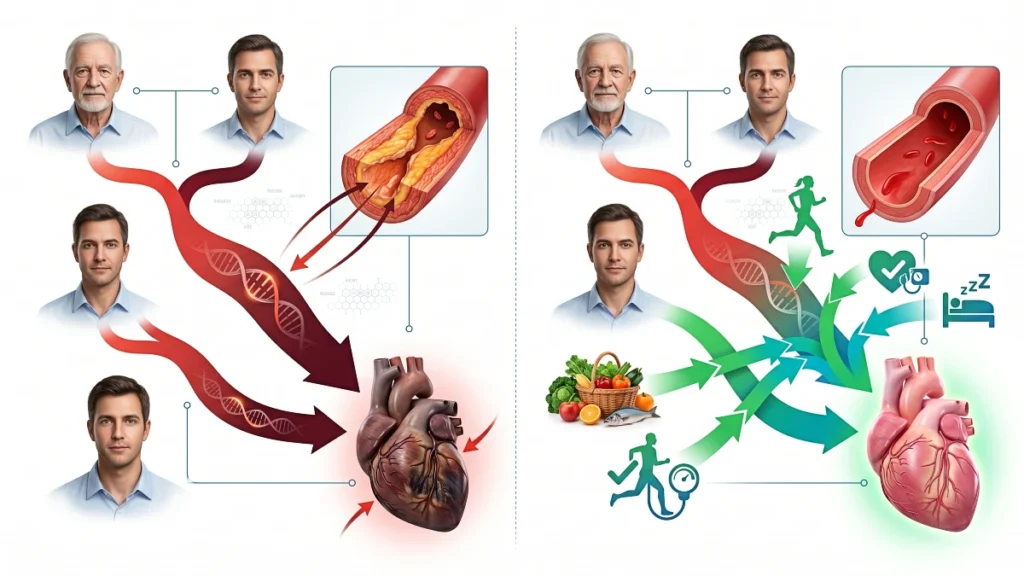
First, you need to know if you actually fit the clinical definition of high risk. Doctors define premature heart disease very specifically. It means a male relative had a cardiac event before age 55, or a female relative had one before age 65.
If this matches your family tree, your cardiovascular risk requires immediate attention.
This risk comes from two places. You share genetics with your parents, like inherited high cholesterol. But you also share environments. The meals you ate as a kid and exposure to secondhand smoke both play a massive role.
Time makes early action critical. The famous Framingham Heart Study proves this point clearly. Data shows that a cardiovascular event in at least one parent doubles the 8 year risk of cardiovascular disease for men.
It increases the risk by 70 percent for women. Furthermore, data from the American Heart Association shows that 1 in 5 heart attacks now occur before age 50.
You cannot change your DNA. You can completely change how those genes express themselves. Your daily choices dictate whether those dangerous genes turn on or stay quiet.
The 2026 Medical Blueprint: Tests You Need to Demand

Standard annual physicals often miss hidden heart disease completely. A basic cholesterol check is no longer enough to protect you. Medical experts now focus on proactive screening for adults starting at age 30.
Are your standard cholesterol tests missing the whole picture? Yes, they probably are.
The 2026 guidelines from the American College of Cardiology and American Heart Association demand better testing. You need to ask for these specific tests:
Advanced Heart Testing
Lipoprotein(a) Blood Test
Lipoprotein(a) is a genetically inherited, sticky type of cholesterol completely missed by standard panels. The newest guidelines recommend measuring this at least once in adulthood.
Coronary Artery Calcium (CAC)
Think of a CAC scan as looking for rust inside the pipes of your house before a leak happens. It identifies hidden atherosclerosis (plaque buildup in the arteries).
ApoB Blood Test
This test counts the exact number of destructive particles in your blood. It gives a much clearer, high-resolution picture than a basic LDL test.
- Lipoprotein(a) blood test: Lipoprotein(a) is a genetically inherited, sticky type of cholesterol. Standard lipid panels completely miss it. The newest guidelines formally recommend measuring this at least once in adulthood.
- Coronary Artery Calcium scan: This is often called a CAC scan. Think of a CAC scan as looking for rust inside the pipes of your house before a leak happens. It identifies hidden atherosclerosis. Atherosclerosis simply means plaque buildup in the arteries.
- ApoB blood test: This test counts the exact number of destructive particles in your blood. It gives a much clearer picture than a basic LDL test.
The new guidelines suggest you should lower LDL cholesterol targets to under 100 mg/dL if you have intermediate risk. You must advocate for yourself.
Take this exact script to your next appointment: “Doctor, because of my family history, I would like to check my Lipoprotein(a) and discuss a calcium scan.”
Know Your Numbers: The AHA PREVENT Calculator

The AHA PREVENT calculator is the biggest 2026 upgrade in preventative cardiology. This tool is now the gold standard for clinical care. It gives you a clear look at your future.
Older calculators were flawed. They only looked at short timeframes and ignored younger adults. The PREVENT tool is vastly different. It measures both your 10 year and 30 year risk. It includes heart failure risk. It also applies to adults as young as 30.
The American Heart Association built this tool using data from 6.5 million people. Seeing your 30 year risk on a screen provides a massive psychological benefit. It shows you exactly where you stand.
You need these specific numbers to use the tool:
- Your exact age and biological sex
- Body Mass Index numbers
- Current blood pressure readings
- Total cholesterol and HDL cholesterol numbers
- Your smoking status
- Your family history of heart disease
Go to the official American Heart Association website and find the PREVENT calculator. Run your numbers today so you can take immediate action.
| Time of Day | Action to Take | Why It Helps Your Heart |
| 7:00 AM | Eat a high fiber breakfast like oatmeal. | Fiber literally pulls bad cholesterol out of your body. |
| 10:00 AM | Stand up and take a brisk 10 minute walk. | This breaks up sitting time and lowers your resting blood pressure. |
| 12:30 PM | Eat a no reheat lunch packed with leafy greens. | A daily Mediterranean diet lowers dangerous inflammation in your arteries. |
| 3:00 PM | Grab a high protein office snack like raw almonds. | This gives you clean energy and provides healthy fats for your heart. |
| 5:30 PM | Complete 20 minutes of moderate aerobic exercise. | This hits your weekly movement goal and makes your heart muscle stronger. |
| 9:30 PM | Turn off all screens and prepare for 8 hours of sleep. | Deep sleep lowers your cortisol levels so your blood vessels can heal. |
Daily Habits That Override Your Genetics

Medication is only half the battle. Your daily lifestyle provides the true foundation for a long life.
You must focus your diet on whole foods. The Mediterranean diet is clinically proven to naturally lower ApoB and help you lower LDL cholesterol. Fiber acts like a sponge in your body. Fiber literally pulls dangerous cholesterol out of your bloodstream.
You also need to move your body consistently. Aim for 150 minutes of moderate aerobic activity every single week. Data shows that sitting excessively and lacking exercise can nearly double the risk of poor heart health. This happens independently of your genetics.
Finally, you must control your stress and sleep. Chronic sleep deprivation floods your body with cortisol. Cortisol is a stress hormone that rapidly accelerates arterial damage. You need 7 to 8 hours of quality sleep to let your blood vessels heal.
Perfection is not required. Consistency is what matters to prevent premature heart disease.
3 Signs You Need a Preventative Cardiologist Now

Most people wait for a heart problem to see a specialist. Your family history means you cannot afford to wait. A primary care doctor handles general health. A preventative cardiologist focuses strictly on keeping your arteries clear.
You need to build a strong medical team. Here are three clear signs you need to upgrade your doctor:
3 Signs You Need to Upgrade Your Doctor
Dismissed History
They brush off your family history, ignoring critical genetic clues that are essential for preventative, proactive healthcare.
Testing Refusals
They refuse to order a Lipoprotein(a) blood test, denying you access to modern, necessary cardiovascular diagnostics.
Vague Advice
They tell you to just “watch your diet” instead of actively developing a structured, actionable, and real medical plan.
If your primary doctor says “let us wait and see,” find a new doctor. You need a medical partner who looks at your advanced blood work. Sometimes your genetics are too strong to fight with food alone.
A specialist can tell you if you need medication to stay safe. New medicines available in 2026 can safely lower your risk without ruining your daily life.
A good doctor will build an aggressive defense plan to protect your heart. Do not settle for a physician who ignores your genetic risk.
Take Action Today
Genetics load the gun. Lifestyle and modern medicine pull the trigger. You possess the power to rewrite your cardiovascular future completely.
Do not let fear stop you from getting the facts. Schedule an appointment with your primary care physician this week. Explicitly ask for a Lipoprotein(a) blood test to uncover any hidden genetic risks.
Then, gather your recent medical data and run your numbers through the online PREVENT calculator.
You can beat a family history of heart disease. Take these exact steps today to protect your heart for decades to come.