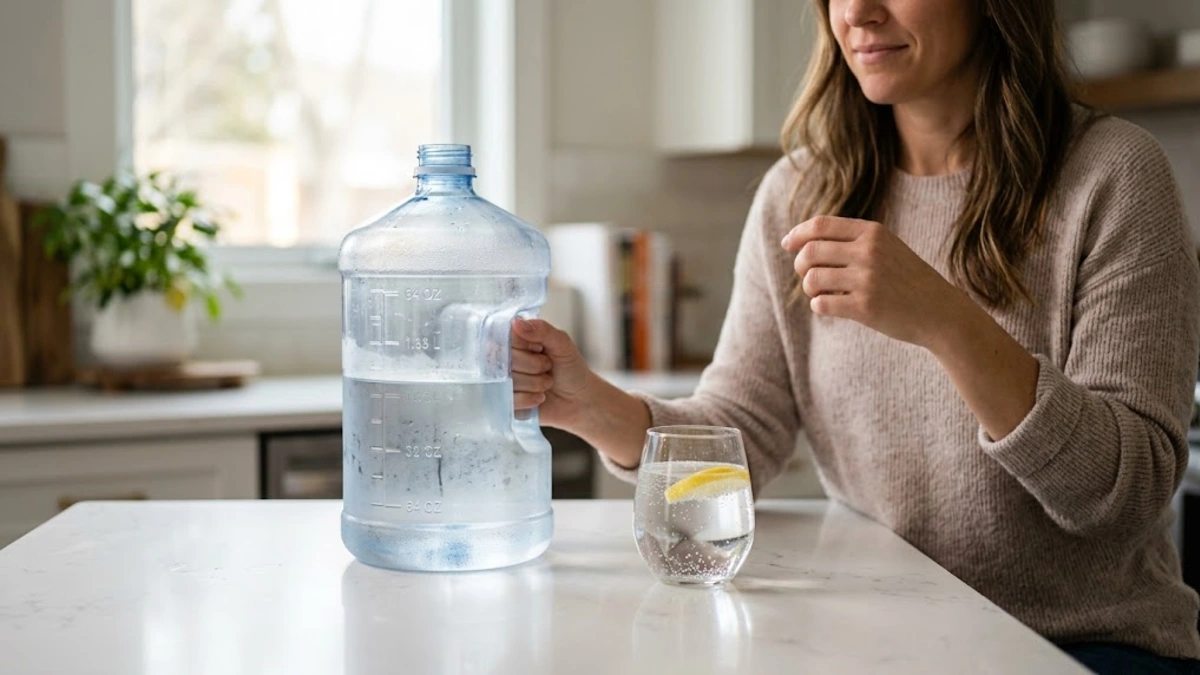
If you are currently forcing yourself to chug from a massive water bottle just to hit your daily quota, you can put it down. The relentless pressure to drink water even when you are not thirsty causes unnecessary anxiety.
It also leads to frequent and frustrating trips to the bathroom. You might think you are doing the right thing for your health. But the truth is much simpler.
Today, we are looking closely at the 8 glasses of water a day myth. You will learn about the absurd historical accident that created this rule. We will review the massive scientific studies that completely dismantled it.
The 1945 Typo: Where the 8 Glasses of Water a Day Myth Began
To see why we are drowning ourselves in water today, we have to travel back to 1945. That year, the US Food and Nutrition Board released a simple dietary recommendation. They stated that a suitable allowance of water for adults is 2.5 liters daily in most instances.
This volume equals roughly 64 ounces. That translates perfectly to eight 8 ounce glasses of water. People read that first sentence and panicked.
They started tracking every single glass they poured from the tap. They worried about their families getting enough fluids. But poor reading comprehension failed a whole nation.
Almost everyone ignored the critical sentence immediately following that recommendation. The board clearly wrote that most of this quantity is contained in prepared foods.
You were never supposed to drink all of it from a cup. Your meals were supposed to provide the bulk of your hydration.
This simple mistake created the 8 glasses of water a day myth. Bottled water companies loved this error. They amplified this misinterpretation for profit over the next several decades. They convinced people that normal tap water or food was not enough.
Real daily water intake science was completely pushed aside. Marketing campaigns made us believe we were constantly on the edge of dehydration. For decades, this half read guideline fueled an entire bottled water industry.
Dr. Heinz Valtin and the Lack of Scientific Evidence

It took over 50 years for a doctor to officially call the rule out. Dr. Heinz Valtin is an Emeritus Professor of Physiology at Dartmouth Medical School.
He spent 10 full months searching for the scientific origin of the rule. He wanted to know exactly how much water should I drink according to the data.
He found absolutely nothing. Dr. Valtin published a peer reviewed report in the American Journal of Physiology in 2002. His conclusion was shocking to many people. There is absolutely no scientific evidence supporting the rule for healthy adults in temperate climates.
Dr. Valtin realized that forcing water does not flush toxins any better than drinking normally. Your kidneys already filter about 180 liters of blood daily. They are incredibly efficient organs. Drinking excess water just creates more urine.
In fact, there is a very real downside to over hydration. Forcing too much fluid can lead to water intoxication. Doctors call this condition hyponatremia. This happens when excess water dilutes the sodium levels in your blood.
It causes your brain cells to swell. The symptoms range from mild confusion to severe medical emergencies. But if Valtin fired the warning shot in 2002, a massive global study recently dropped the bomb.
The 2022 Science Study That Finally Buried the Rule

In November 2022, the journal Science published the most comprehensive study on human hydration ever conducted.
Evolutionary Anthropologist Herman Pontzer at Duke University led this massive project. The researchers completely dismantled the 8 glasses of water a day myth with hard data.
The methodology was incredibly precise. They used a technique called the Doubly Labeled Water method. This is the gold standard for measuring energy and water turnover in the body. It tracks special isotopes through your system to see exactly how much water you use.
The researchers tested 5604 people across 23 countries. The participants ranged in age from 8 days old to 96 years old.
The researchers tracked these people as they went about their normal lives. The new daily water intake science proved that our needs are highly individual.
The old one size fits all guess was completely wrong. Here are the key takeaways from the study regarding water turnover:
Hydration Variables
Personalizing Your Fluid Intake
Age & Metabolism
Age drastically changes how much water your body uses. Metabolic rates and kidney functions naturally shift over time, altering baseline fluid requirements.
Body Mass
Larger body sizes inherently require more fluid to function properly. Total blood volume and cellular composition scale directly with physical dimensions.
Environment
Hot climates and high altitudes exponentially increase water needs. Dry air and high temperatures cause invisible fluid loss through accelerated respiration and evaporation.
Physical Output
Physical activity levels dictate exactly how much sweat you lose. Intense exertion requires immediate and proportional replenishment to maintain muscle function and core temperature.
Your body uses water differently than your neighbor does. A construction worker in Texas needs vastly more fluid than an office worker in London. The definitive scientific conclusion? A single daily water target is biologically illogical.
You Are Already “Drinking” Water When You Eat

Here is the biggest secret the rule ignores: You chew a lot of your water. You do not need to constantly ask how much water should I drink from a cup. A huge percentage of your daily hydration comes from solid foods.
Every time you eat a salad or a piece of fruit, your body absorbs liquid. Your digestive system pulls the moisture directly from the food. Many fruits and vegetables are essentially edible drinks.
Here is the water content of some common healthy foods:
- Cucumbers are 96 percent water.
- Strawberries are 92 percent water.
- Apples are 84 percent water.
- Potatoes are 79 percent water.
There is also a persistent secondary myth we need to bust. Many people think coffee and tea dehydrate you. Science shows this is completely false.
Caffeinated beverages actually contribute to your daily fluid totals. Your morning coffee is not dehydrating you; it is adding to your daily fluid intake.
If Not 8 Glasses, How Much Water Should I Drink?
If we throw out the old rule, what replaces it? You might still be wondering how much water should I drink on a normal Tuesday. The answer lies in the evolutionary perfection of the human thirst mechanism.
Your brain is incredibly smart. It uses a process called osmoregulation to monitor your blood concentration. When you need water, your brain makes you thirsty. You should simply drink when you feel thirsty.
You can also use the visual urine test as a practical daily metric. This tells you exactly what is happening inside your body without guessing. Ever wonder why you are peeing clear every hour but still feel parched? You are drinking past your limits.
Here is how to read the visual signs:
The Hydration Spectrum
Visual Diagnostics
Perfectly Hydrated
Pale yellow urine means you are perfectly hydrated. It indicates an ideal balance of water in your system and should look like light lemonade.
Overhydrated
Clear urine means you are drinking too much. You are just flushing water straight through your system without giving your body time to absorb it.
Dehydrated
Dark urine is one of the main signs of dehydration. It looks more like apple juice and means you need a drink immediately to replenish fluids.
There are a few exceptions to this natural rule. The elderly need to be careful because their thirst reflex naturally fades with age. High performance athletes and people working in extreme heat must also plan their fluid intake ahead of time.
Top Foods for Natural Hydration
| Food Item | Water Content | Extra Health Benefit |
| Cucumber | 96% | Good for your skin and joints |
| Celery | 95% | High in helpful fiber |
| Tomatoes | 94% | Packed with Vitamin C |
| Watermelon | 92% | Helps reduce muscle soreness |
| Strawberries | 92% | Full of disease-fighting antioxidants |
| Cantaloupe | 90% | Great for your eye health |
| Peaches | 89% | Helps keep your digestion on track |
| Apples | 84% | Keeps you feeling full longer |